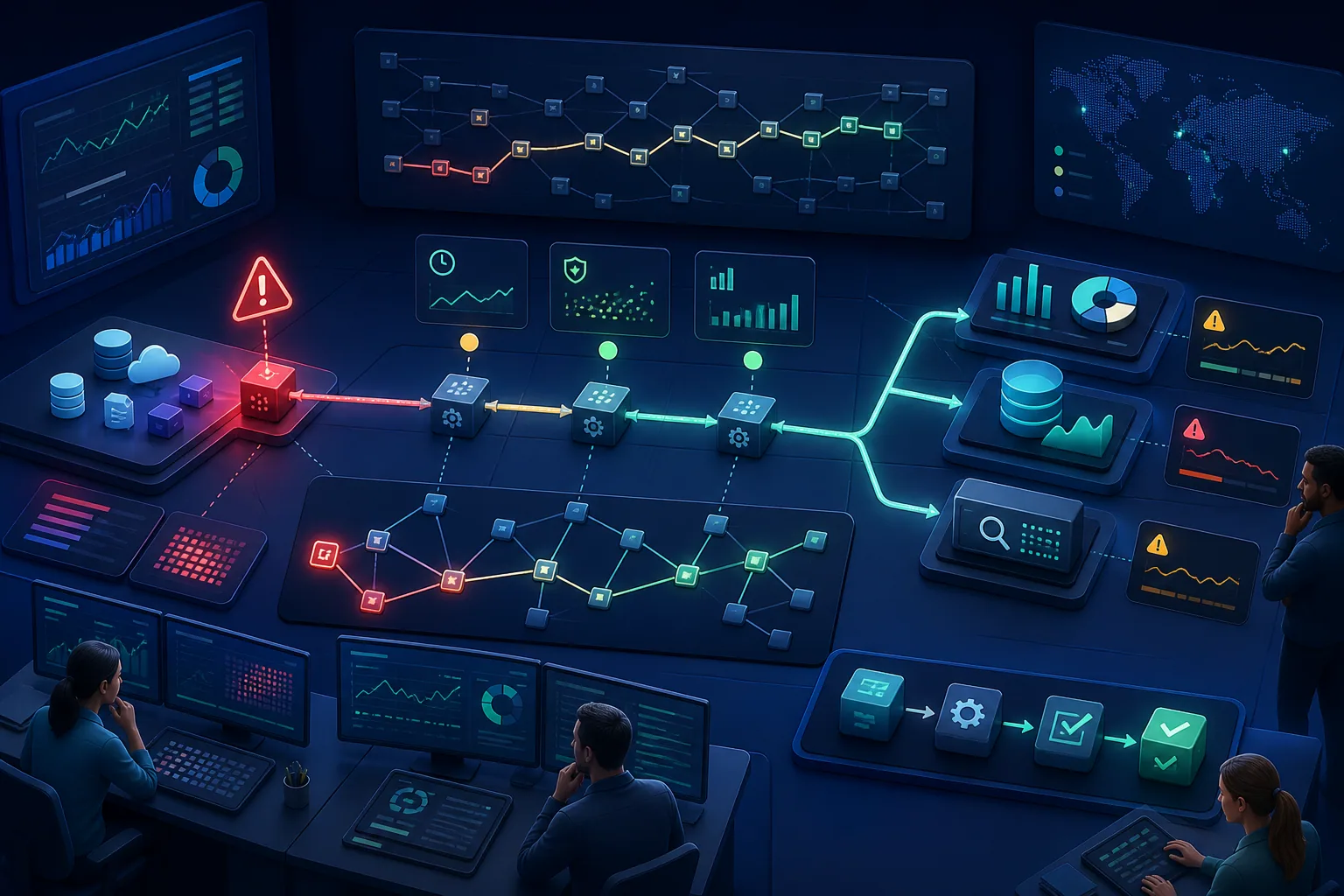
Data observability for AI is the ability to detect, explain and recover from data failures before they silently change analytical, model or agent outcomes. It combines service measures, quality rules, lineage, ownership and incident response.
Direct answer
Monitor five questions for every critical data product:
- Did the expected data arrive on time?
- Is its volume and structure plausible?
- Does it satisfy business and privacy rules?
- Which downstream models, indexes and decisions use it?
- Who owns diagnosis, recovery and consumer communication?
Dashboards without ownership and response behavior are telemetry, not an operating capability.
Observe the full data journey
AI pipelines may include source extraction, event transport, transformation, feature computation, document parsing, chunking, embedding, indexing, evaluation and serving. Record run, dataset and version identifiers across these steps.
Google Cloud’s AI/ML reliability guidance recommends centralized records of data and model versions for traceability and auditing. See the official reliability guidance. The principle remains relevant across cloud providers.
Define service indicators
Useful indicators include:
- freshness against the consumer’s decision window;
- successful and late run percentage;
- source-to-serving latency;
- row, event, document and tokenized-content volume;
- schema and contract compatibility;
- null, uniqueness and referential failures;
- distribution and category change;
- permission and classification completeness;
- failed or stale index updates.
Tie each indicator to a service objective and response. A fixed daily freshness target may be unnecessary for monthly reporting and inadequate for operational fraud detection.
Use lineage for impact, not decoration
OpenLineage defines an open framework that records metadata about datasets, jobs and runs to support root-cause and impact analysis. See the OpenLineage specification overview. Apache Airflow also maintains an official OpenLineage provider.
During an incident, lineage should help answer:
- which run first produced the anomaly;
- which source and transformation version participated;
- which consumers received the affected version;
- which features, documents or indexes need replay;
- which owners require notification.
Validate lineage completeness. Missing custom jobs or manually uploaded data can create false confidence.
Add AI-specific failure checks
Structured-data health does not prove retrieval or model health. Add checks for:
- documents parsed without meaningful content;
- chunks detached from source or permissions;
- stale embeddings after a document update;
- deleted content remaining searchable;
- training and evaluation leakage;
- category or language shifts;
- features computed with a different time boundary;
- source citations that no longer resolve.
Test whether the application can degrade safely. A retrieval service may need to exclude an affected collection, display freshness or route the request to a human rather than continue with stale evidence.
Run data incidents like service incidents
Create severity based on consumer and business impact. Assign an incident owner, preserve affected versions, stop further propagation where necessary, identify impacted decisions, correct the source or transformation, replay safely and verify downstream recovery.
The post-incident review should update the contract, monitor, ownership or architecture that allowed the failure. Measure detection time, impact-assessment time, recovery time, recurrence and percentage of affected consumers identified automatically.
Controlled failure exercise
A valuable lab deliberately introduces a schema break, late source, duplicated event, missing permission field and stale document. Learners should detect each failure, trace its impact, choose whether to block or degrade, execute the runbook and prove recovery.
The AI-Ready Data Contract Lab includes this controlled incident path using synthetic data. The full program adds platform-level observability, access evidence and a production-readiness defense.
Frequently asked questions
Is data observability the same as data quality?
No. Quality rules test data expectations. Observability also covers service behavior, pipeline operation, lineage, impact, ownership and recovery.
Does lineage automatically identify the root cause?
It narrows the investigation by showing dependencies, jobs, datasets and runs. Engineers still need evidence to determine which change or failure caused the outcome.
How do we avoid alert fatigue?
Alert on consumer-impacting service objectives and actionable contract failures. Route signals to named owners, tune thresholds with history and remove monitors that have no response.
Explore AI-Ready Data Engineering or request a corporate data reliability lab.