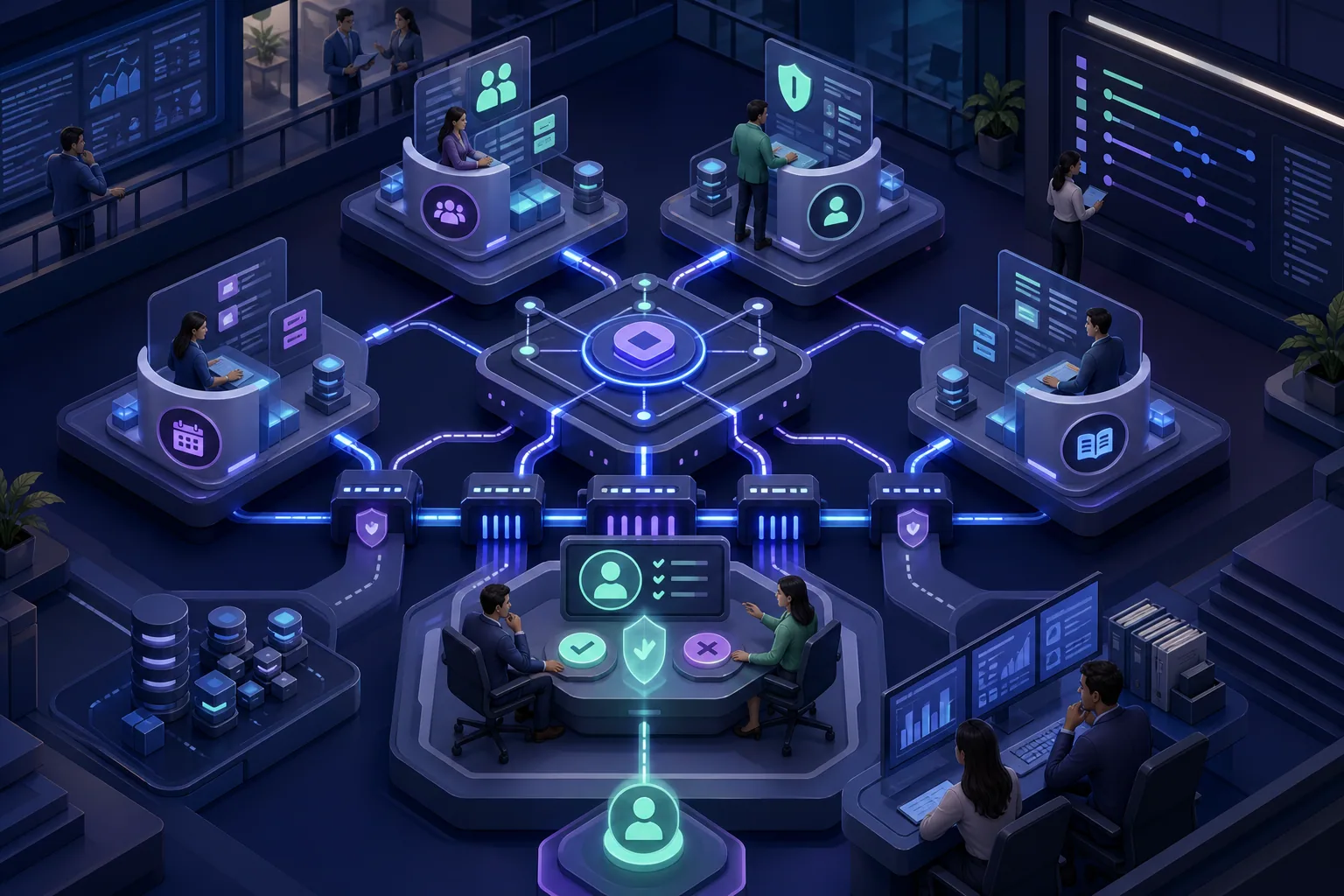
A role-based AI agent should represent a bounded responsibility, not a digital job title with unrestricted access. Define its goal, allowed decisions, tools, data, identity, escalation path and success measure before choosing an agent framework.
Direct answer
The core architecture has five layers:
- trigger and user context — who requested the work and why;
- orchestration and state — which role owns the current step;
- governed tool gateway — the only route to enterprise systems;
- policy and approval — authorization outside the model; and
- evaluation and audit — evidence of decisions, actions and outcomes.
This structure lets an agent interpret variable context without granting the model direct, ambient access to ERP, CRM, identity or ticketing systems.
Define roles by responsibility and permission
For each role, document:
- one primary outcome;
- information it may read;
- actions it may request;
- actions it must never perform;
- conditions requiring another role or person;
- tool and data owner;
- evaluation scenarios.
Consider an employee-onboarding workflow:
| Role | Responsibility | Example access |
|---|---|---|
| Intake role | Validate the request and required fields | Read approved HR request; no account creation |
| Policy role | Determine standard entitlement package | Read policy knowledge; return a structured recommendation |
| Identity role | Request approved account and group actions | Call identity tools with least privilege; no policy editing |
| Coordinator | Track state, failures and handoffs | Workflow state and task system; no direct privileged action |
| Human approver | Authorize sensitive access | Review evidence and accept or deny |
Role separation is valuable only if it creates a real boundary. Giving every role the same credential and context produces multiple agent names without meaningful control.
Put a tool gateway between agents and systems
Expose narrow capabilities such as get_employee_request, search_policy, create_standard_ticket or request_group_assignment. The contract should validate required fields and reject unexpected inputs.
The gateway should enforce identity, authorization, tenant boundaries, rate limits, idempotency and logging. It should return structured errors that the workflow can handle without inventing a successful result.
OpenAI’s agent guide identifies tools, instructions and orchestration as design foundations and states that guardrails should be combined with authentication, authorization and standard security controls. See the official agent-building guide.
Choose the integration pattern deliberately
- Use synchronous APIs when the response is quick and the caller needs an immediate result.
- Use events or queues when work is long-running, retryable or should be decoupled.
- Use a workflow engine for durable state, timers, compensation and human tasks.
- Use an approved connector or MCP-compatible server only after reviewing its authentication, authorization, data access, action surface and operating ownership.
MCP describes a method for exposing tools and context, but it does not remove the need to secure the underlying system or decide what the agent should be allowed to do.
Keep workflow state outside conversational memory
Store business state in a durable, queryable system. Record the current step, inputs, tool results, approvals, retry count, timeout and final outcome. Conversational context can help the model reason, but it should not be the only record of a business transaction.
Define compensation for partial completion. If the ticket was created but the identity service failed, the workflow must know whether to retry, reverse, wait or ask a person.
Apply human approval to meaningful boundaries
Approval should be attached to risk, not every minor step. Examples include privileged access, external communication, financial commitment, deletion and actions without straightforward reversal.
Show the approver the requested change, policy evidence, affected user and system, agent recommendation, source records and rollback option. Capture the approver identity and decision.
Evaluate the complete workflow
Test normal, missing-data, conflicting-policy, denied-access, duplicate-event, system-outage and malicious-content cases. Measure task completion, tool selection, handoff correctness, unauthorized-action prevention, latency, retries, human-review load and unit cost.
An agent that produces a good final explanation after performing an incorrect tool action has failed.
Practical lab: integrate a bounded agent
In the Enterprise AI Agent Integration Lab, participants connect a role-based agent to approved knowledge and a simulated ticketing system, add an approval checkpoint and record an audit trail. The full program extends this to a multi-role onboarding workflow.
Frequently asked questions
Does each role require a separate model?
No. Roles can share a model while using different instructions, tools, context and identities. Model selection should follow task quality, latency, cost and data requirements.
Can agents connect directly to an ERP database?
Avoid broad direct database access. Prefer supported application APIs or a governed service that enforces business rules, authorization and audit requirements.
What is the difference between an agent role and a microservice?
A microservice implements defined software behavior. An agent role uses a model to interpret context and select actions within bounds. The agent should call deterministic services rather than replace their validation and transaction logic.
View the Enterprise AI Agent Engineering curriculum or request a corporate integration cohort.